
Budget 2026: Nonprofits deliver on Canada's priorities, but where's the plan for the sector?
On November 5, Finance Minister and Minister of National Revenue tabled Budget 2026 in the House of Commons, laying out an ambitious economic vision built on major investments in housing, infrastructure, productivity and culture.
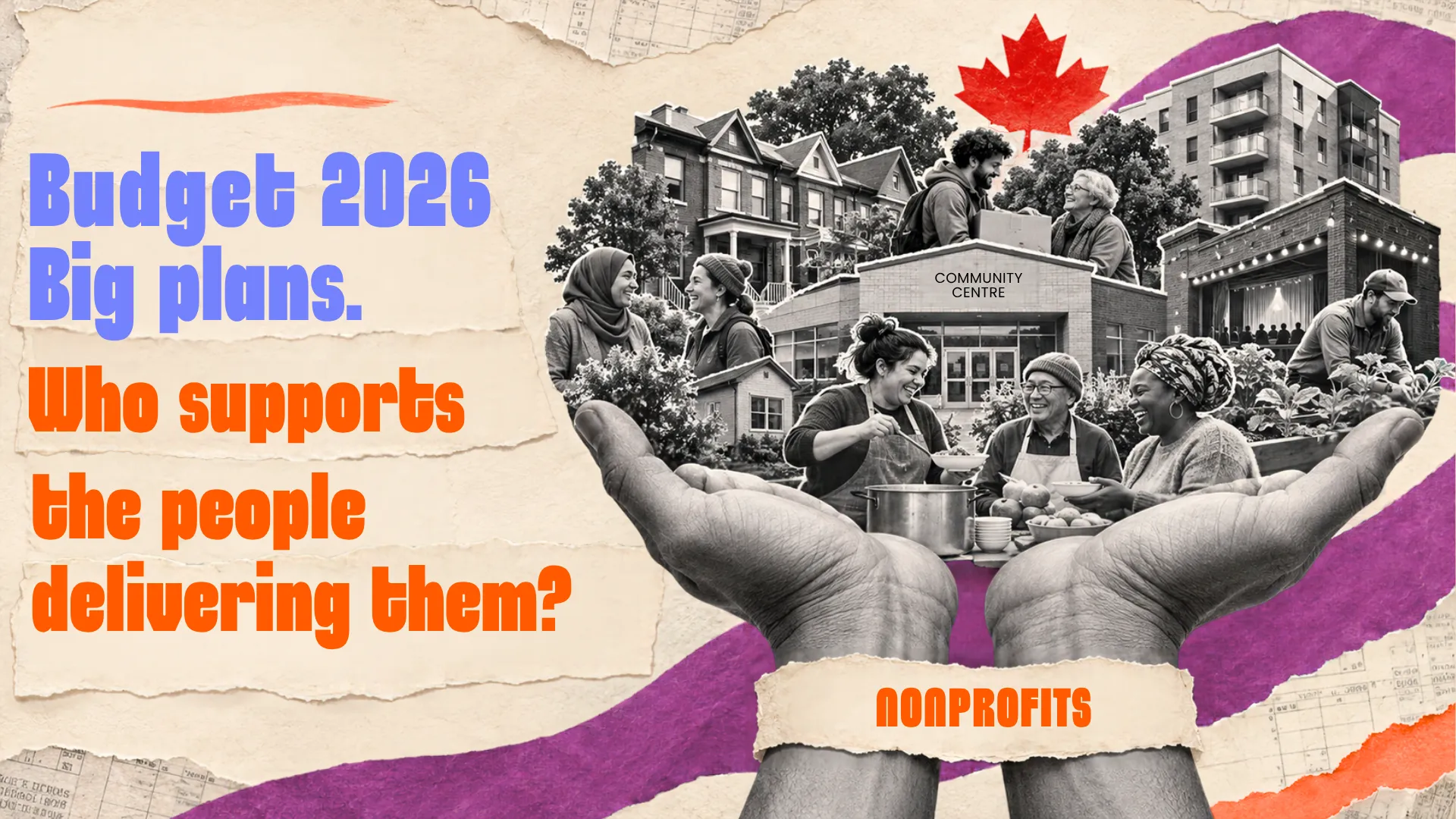
On November 5, Finance Minister and Minister of National Revenue tabled Budget 2026 in the House of Commons, laying out an ambitious economic vision built on major investments in housing, infrastructure, productivity and culture.
Nonprofits have a seat at that table. The budget recognizes the sector as a partner in delivering on some of the country's biggest priorities: housing, mental health and gender equality.
And yet the sector itself is barely visible in the government's broader economic vision. This is a sector that contributes 8.4% of Canada's GDP and employs one in ten Canadian workers. Canadians rely heavily on this sector: two in five reported using a charity or nonprofit's services in the past year. So why is there no comprehensive strategy to strengthen it?
Sector leaders noticed the gap. Imagine Canada's read on the budget was administrative streamlining with targeted investments, but no vision: the budget, they noted, lacks the acknowledgement of the sector's economic and social role that the government's own spring economic statement offered, and lays out no policy plan for building the strong, modern, caring sector the country will need. The House Finance Committee's proposal for a dedicated social sector fund, investing in shared infrastructure and capacity building, quietly disappeared.
Nonprofits are being asked to help deliver the country's biggest priorities. The question the budget leaves unanswered: will they get the support to actually do it?

First, let's give credit where credit is due
There are welcome moves. The budget eliminates the excess corporate holdings regime for private foundations, freeing them to focus on grantmaking. The deadline for filing a notice of objection extends from 90 days to a year. The new Build Canada Exchange will let nonprofit and charity experts take temporary assignments inside government, bringing sector experience into policy design.
And the funding that flows through nonprofit hands is helpful: $2 billion for a Health Infrastructure Fund for community mental health and addictions facilities, $124 million for the Local Food Infrastructure Fund supporting food banks and community food organizations, renewed funding under the 2SLGBTQI+ Action Plan, and major investments in homelessness prevention and supportive housing.
A cool Win: Caregiving is recognized!
Let’s start with the win that deserves to be named: caregivers are finally better recognized in the budget. The Canada Caregiver Credit becomes fully refundable, worth up to $1,260 a year to 585,000 caregivers, including 180,000 who currently receive nothing because their incomes are too low to owe tax. That's $845 million over four years, and it's expected to lift an estimated 15,000 people out of poverty.
This matters because caregiving is the invisible workforce that fuels our care economy. Advocates have pushed for this for years, and the Canadian Centre for Caregiving Excellence reported that 83% of caregivers said a refundable credit would help their financial situation. The budget listened. That is what sector advocacy looks like when it works, and it deserves celebration.
Women Programs Deserve more
Budget 2026 protects the progress we've made and keeps building on it. For instance, women’s Program is $8 million over four years, starting in 2027-28, and $2 million ongoing to support organizations working to advance equality for women and address systemic barriers. This includes projects that support women entrepreneurs, increase women's representation in leadership, and help address gender-based violence.
I wish there was one more zero at least in this budget section. Can you imagine the competition and scarcity mindset this amount will stir. Organizations advancing women leadership, fighting violence and supporting more than 50% of the population deserve more. One cannot be strategic when they’re operating on crumbs.
The AI moment the sector can't afford to miss
Here's the opportunity hiding in plain sight. The budget doubles down on Canada's AI for All strategy, and adoption is moving fast: the share of Canadian firms using AI has more than tripled since 2024, from 6.1% to 19.2%. A $1 billion Government Transformation Fund will accelerate digital service delivery across government, and regional development agencies are funding AI adoption directly.
Nonprofits are being asked to deliver more with less, in a labour market where every hour counts. AI and digital tools, done ethically, can take the administrative weight off frontline staff and put it back into mission. The funding windows for this shift are open now, and the organizations that move early will be the ones still standing when the demand curve keeps climbing.

Nonprofits will need to find their footing.
These numbers matter for the budget picture too. There are welcome administrative and regulatory changes, and they're worth noting. But on what matters most for the long haul, stable funding, infrastructure and organizational capacity, the budget is largely silent, even as community needs keep growing. Nonprofits need to find support for their footing in unconventional spaces.
The AI and digital funding on the table is one place the answer can be yes. We are eager to support our partners in this shift, and there are now many funding opportunities to do it. Reply and we'll share them, and help you think through which ones fit. At YAMM, we are building ethical, impact-focused technology, and we'd love to talk more about it.